| soorya |
Simple Servo Controller |
Wednesday, May 30, 2012 2:57:58 AM |
| what should we give in the controller?? i mean how should be the input?? could you give a table of inputs and the angle turned??? |
| wasi |
Simple Servo Controller |
Thursday, November 03, 2011 3:55:25 AM |
| yesterday i assemble this ckt .this ckt does not work when i inserted the R2 resistor of 68 kilo ohm wit base of transistor in series
|
| Edwin Smith |
Simple Servo Controller |
Tuesday, October 11, 2011 5:09:53 AM |
| I need some help changing this circuit. I have a single on of switch and want to us it to set the servo to minimum and maximum by simply turning it on or off. Will proley be good to have a variable pot in order to set the minimum/maximum position to fine tune. Please advise. I wanna make a number plate flipper for my bike with a servo. So On must be flipped up and off must be flipped down. |
| ACA |
Simple Servo Controller |
Sunday, July 03, 2011 9:38:42 AM |
| Question : can the other comparator be used to sense voltage drop in the vcc,and set different values for pin 6,as to make it switch H and V skew depending on receiver polarity? |
| ACA |
Simple Servo Controller |
Sunday, July 03, 2011 9:19:01 AM |
| I would like to suggest to add an IC where the pot is,and use the 13v/18v as reference to vary the resistance between 2 states for U1,in this way,you can feed the power from the LNB cable,and it will be possible to change skew according to polarity automatically.,with no power supply needed. |
| Arno |
Simple Servo Controller |
Wednesday, March 02, 2011 10:11:06 AM |
| Normaly, it will work with all kind of servo, maybe not with the digital ones..?!! But, like said in the comment uper, it is just a question of wire's color ! |
| richard |
Simple Servo Controller:::::question |
Wednesday, December 29, 2010 7:36:24 PM |
| is it working in other servo motor or only in Futaba servos? |
| mrel |
Simple Servo Controller |
Saturday, November 06, 2010 8:39:55 PM |
| Schematic not to clear
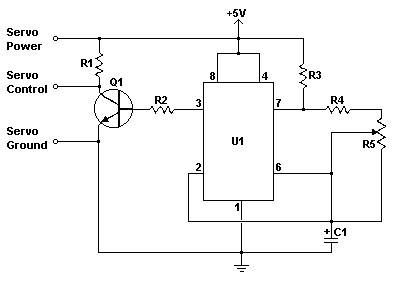
U1 (555) Is Capacitor C1 postive side connected Pin (1) and to Pin (2) and Pin (6) of U1 (555) chip?
mrel |
| Fadil |
Simple Servo Controller |
Saturday, September 25, 2010 11:02:10 PM |
| Just like craig and john said earlier...I have the same problem too.All I need is to control the motor from 90 to 0 and 0 to 90.But my servo twitches once whenever I switch the circuit on.Please help me |
| Tony |
Simple Servo Controller |
Friday, August 06, 2010 2:14:50 PM |
| I hooked up the circuit on a proto board--it works pretty well, but I found it sort of noisy. In "Practical Electronics for Inventors," by Paul Scherz, it shows a 1000uF cap across the positive and negative inputs to the motor (page 933 of 2nd Edition). I tried a 5uF one and it cured the noise. |